

25 Divided By 2 5


The ancient Egyptian agenda – a civil agenda – was a solar calendar with a 365-day year. The year consisted of three seasons of 120 days each, plus an intercalary calendar month of five epagomenal days treated equally exterior of the year proper. Each season was divided into four months of 30 days. These twelve months were initially numbered inside each flavour but came to too be known by the names of their master festivals. Each month was divided into iii ten-solar day periods known as decans or decades. It has been suggested that during the Nineteenth Dynasty and the Twentieth Dynasty the last 2 days of each decan were usually treated as a kind of weekend for the royal craftsmen, with royal artisans gratis from work.[2]
Considering this calendrical year was nearly a quarter of a day shorter than the solar yr, the Egyptian calendar lost about 1 24-hour interval every four years relative to the Gregorian agenda. Information technology is therefore sometimes referred to as the wandering year (Latin: annus vagus), as its months rotated about i day through the solar year every four years. Ptolemy III'due south Canopus Decree attempted to correct this through the introduction of a sixth epagomenal twenty-four hours every four years simply the proposal was resisted by the Egyptian priests and people and abandoned until the institution of the Alexandrian or Coptic calendar by Augustus. The introduction of a leap 24-hour interval to the Egyptian calendar made it equivalent to the reformed Julian calendar, although past extension it continues to diverge from the Gregorian agenda at the turn of most centuries.
This civil calendar ran concurrently with an Egyptian lunar calendar which was used for some religious rituals and festivals. Some Egyptologists have described information technology as lunisolar, with an intercalary month supposedly added every two or three years to maintain its consistency with the solar year, but no prove of such intercalation earlier the 4th century BC has yet been discovered.
History [edit]
Prehistory [edit]
Setting a calendar by the Nile inundation would exist almost as vague a business equally if we set our agenda past the render of the Spring violets.
—H.E. Winlock[3]
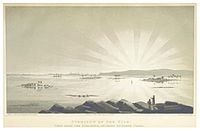
The Nile flood at Cairo c. 1830.
Current understanding of the earliest development of the Egyptian agenda remains speculative. A tablet from the reign of the First Dynasty pharaoh Djer (c. 3000 BC) was one time thought to signal that the Egyptians had already established a link betwixt the heliacal rising of Sirius (Ancient Egyptian: Spdt or Sopdet, "Triangle"; Greek: Σῶθις , Sôthis) and the beginning of their year, but more contempo analysis has questioned whether the tablet'southward picture show refers to Sirius at all.[four] Similarly, based on the Palermo Stone, Alexander Scharff proposed that the Old Kingdom observed a 320-day year, but his theory has not been widely accustomed.[five] Some evidence suggests the early on civil calendar had 360 days,[half dozen] although information technology might just reflect the unusual status of the five epagomenal days as days "added on" to the proper year.
With its interior effectively rainless for thousands of years,[seven] ancient Egypt was "a gift of the river" Nile,[eight] whose almanac flooding organized the natural year into three broad natural seasons known to the Egyptians as:[9] [ten] [11]
- Inundation or Flood (Ancient Egyptian: Ꜣḫt, sometimes anglicized as Akhet): roughly from September to January.
- Emergence or Winter ( Prt , sometimes anglicized as Peret): roughly from Jan to May.
- Depression Water or Harvest or Summer ( Šmw , sometimes anglicized as Shemu): roughly from May to September.[ix]
As early on as the reign of Djer (c. 3000 BC, Dynasty I), yearly records were being kept of the flood'due south high-water mark.[12] Otto Due east. Neugebauer noted that a 365-day yr tin can be established by averaging a few decades of accurate observations of the Nile inundation without any need for astronomical observations,[13] although the great irregularity of the flood from yr to twelvemonth[a] and the difficulty of maintaining a sufficiently accurate Nilometer and record in prehistoric Egypt has caused other scholars to uncertainty that it formed the basis for the Egyptian calendar.[3] [6] [xv]
Annotation that the names of the iii natural seasons were incorporated into the Ceremonious calendar twelvemonth (meet beneath), but equally this calendar year is a wandering yr, the seasons of this calendar slowly rotate through the natural solar year, significant that Civil flavor Akhet/Overflowing only occasionally coincided with the Nile inundation.
Lunar calendar [edit]

A modernistic lunar calendar for 2017
The Egyptians appear to have used a purely lunar agenda prior to the institution of the solar civil agenda[16] [17] in which each month began on the morn when the waning crescent moon could no longer be seen.[xv] Until the closing of Arab republic of egypt's polytheist temples under the Byzantines, the lunar calendar continued to be used every bit the liturgical year of diverse cults.[17] The lunar calendar divided the calendar month into four weeks, reflecting each quarter of the lunar phases.[18] Because the exact time of morning considered to begin the Egyptian day remains uncertain[19] and there is no evidence that any method other than ascertainment was used to determine the beginnings of the lunar months prior to the quaternary century BC,[20] at that place is no sure style to reconstruct exact dates in the lunar calendar from its known dates.[19] The departure between beginning the twenty-four hour period at the first light of dawn or at sunrise accounts for an xi–14 year shift in dated observations of the lunar wheel.[21] Information technology remains unknown how the Egyptians dealt with obscurement past clouds when they occurred and the all-time current algorithms take been shown to differ from actual observation of the waning crescent moon in near one-in-five cases.[19]
Parker and others accept argued for its development into an observational and and then calculated lunisolar calendar[22] which used a xxx day intercalary month every two to iii years to suit the lunar year's loss of nearly xi days a twelvemonth relative to the solar year and to maintain the placement of the heliacal ascension of Sirius within its twelfth month.[16] No evidence for such a month, however, exists in the present historical tape.[23]
| Temple Month Ꜣbd north ḥwt-nṯr [24] |
|---|
| Egyptian hieroglyphs |
A 2d lunar calendar is attested by a demotic astronomical papyrus[25] dating to sometime after 144 Advert which outlines a lunisolar calendar operating in accord with the Egyptian civil calendar according to a 25 year wheel.[26] The calendar seems to show its month beginning with the beginning visibility of the waxing crescent moon, just Parker displayed an error in the cycle of about a day in 500 years,[27] using information technology to show the cycle was adult to correspond with the new moon effectually 357BC.[28] This date places it prior to the Ptolemaic menstruum and within the native Egyptian Dynasty XXX. Egypt's 1st Persian occupation, even so, seems likely to take been its inspiration.[29] This lunisolar calendar'southward calculations apparently continued to exist used without correction into the Roman period, even when they no longer precisely matched the observable lunar phases.[30]
The days of the lunar month — known to the Egyptians every bit a "temple month"[24] — were individually named and historic every bit stages in the life of the moon god, variously Thoth in the Middle Kingdom or Khonsu in the Ptolemaic era: "He ... is conceived ... on Psḏntyw; he is built-in on Ꜣbd; he grows old after Smdt".[31]
| Day | Name | |||||||
|---|---|---|---|---|---|---|---|---|
| Egyptian | Meaning (if known) | |||||||
| ane |
| Psḏtyw [d] | Literal meaning unknown but mayhap related to the Ennead; the day of the New Moon. | |||||
| two | [east] | Tp Ꜣbd Ꜣbd | "Beginning the Calendar month" or "The Month"; the beginning of the Crescent Moon. | |||||
| 3 | Mspr | "Arrival" | ||||||
| 4 | Prt Sm | "The Going Forth of the Sm", a kind of priest | ||||||
| 5 |
| I͗ḫt Ḥr Ḫꜣwt | "Offerings upon the Altar" | |||||
| 6 |
| Snt | "The Sixth" | |||||
| vii | [g] | Dnı͗t | "Fractional"; the first-quarter 24-hour interval. | |||||
| 8 | Tp | Unknown | ||||||
| 9 | [h] | Kꜣp | Unknown | |||||
| 10 | Sı͗f | Unknown | ||||||
| 11 | Stt | Unknown | ||||||
| 12 |
| Unknown | "Fractional" the second-quarter solar day. | |||||
| 13 |
| Mꜣꜣ Sṯy | Unknown | |||||
| fourteen |
| Sı͗ꜣw | Unknown | |||||
| 15 |
| Smdt Tp Smdt | Literal significant uncertain; the day of the Full Moon. | |||||
| 16 |
| Mspr Sn Nw Ḥbs Tp [49] | "Second Arrival" "Roofing the Caput" | |||||
| 17 |
| Sı͗ꜣw | Second Quarter Day | |||||
| 18 |
| I͗ꜥḥ | "Twenty-four hour period of the Moon" | |||||
| 19 | Sḏm Mdwf | Unknown | ||||||
| twenty | Stp | Unknown | ||||||
| 21 | [50] | Ꜥprw | Unknown | |||||
| 22 | Pḥ Spdt | Unknown | ||||||
| 23 |
| Dnı͗t | "Partial"; the 3rd-quarter day. | |||||
| 24 | [thou] | Knḥw | Unknown | |||||
| 25 | Stt | Unknown | ||||||
| 26 |
| Prt | "The Going Forth" | |||||
| 27 |
| Wšb | Unknown | |||||
| 28 | Ḥb Sd Nwt | "The Jubilee of Nut" | ||||||
| 29 |
| Ꜥḥꜥ | Unknown | |||||
| 30 |
| Prt Mn | "The Going Forth of Min" | |||||


Ceremonious calendar [edit]
The ceremonious calendar was established at some early date in or before the One-time Kingdom, with probable evidence of its use early on in the reign of Shepseskaf (c. 2510 BC, Dynasty IV) and sure attestation during the reign of Neferirkare (mid-25th centuryBC, Dynasty V).[54] Information technology was probably based upon astronomical observations of Sirius[15] whose reappearance in the sky closely corresponded to the boilerplate onset of the Nile flood through the 5th and 4th millennium BC.[14] [p] A recent development is the discovery that the 30-24-hour interval calendar month of the Mesopotamian calendar dates as belatedly every bit the Jemdet Nasr Menstruum (tardily 4th-millenniumBC),[56] a time Egyptian culture was borrowing various objects and cultural features from the Fertile Crescent, leaving open the possibility that the main features of the agenda were borrowed in one direction or the other as well.[57]
The civil year comprised exactly 365 days,[q] divided into 12 months of 30 days each and an intercalary month of v days,[59] were celebrated every bit the birthdays of the gods Osiris, Horus, Set, Isis, and Nephthys.[60] The regular months were grouped into Arab republic of egypt'southward three seasons,[59] which gave them their original names,[61] and divided into 3 x-day periods known as decans or decades. In later sources, these were distinguished as "outset", "middle", and "concluding".[62] Information technology has been suggested that during the Nineteenth Dynasty and the Twentieth Dynasty the final 2 days of each decan were usually treated as a kind of weekend for the royal craftsmen, with royal artisans free from work.[63] Dates were typically expressed in a YMD format, with a pharaoh's regnal year followed past the month followed by the mean solar day of the month.[64] For case, the New Twelvemonth occurred on I Akhet ane.
| Lord of Years Nb Rnpt |
|---|
| Egyptian hieroglyphs |
The importance of the calendar to Egyptian religion is reflected in the use of the title "Lord of Years" ( Nb Rnpt )[65] for its various creator gods.[66] Time was also considered an integral aspect of Maat,[66] the cosmic order which opposed chaos, lies, and violence.
The civil agenda was evidently established in a year when Sirius rose on its New Yr (I Akhet 1) just, because of its lack of leap years, it began to slowly wheel backwards through the solar year. Sirius itself, nigh xl° below the ecliptic, follows a Sothic year near exactly matching that of the Dominicus, with its reappearance now occurring at the latitude of Cairo (aboriginal Heliopolis and Memphis) on 19July (Julian), but two or 3 days later than its occurrence in early on antiquity.[59] [67]
Post-obit Censorinus[68] and Meyer,[69] the standard understanding was that, four years from the calendar's inception, Sirius would take no longer reappeared on the Egyptian New Yr merely on the next day (I Akhet 2); four years later, it would have reappeared on the day after that; and so on through the entire calendar until its rise finally returned to I Akhet ane 1460 years subsequently the calendar'due south inception,[68] [r] an upshot known as "apocatastasis".[lxx] Owing to the result's extreme regularity, Egyptian recordings of the calendrical appointment of the rise of Sirius have been used by Egyptologists to gear up its agenda and other events dated to information technology, at to the lowest degree to the level of the iv-Egyptian-year periods which share the aforementioned engagement for Sirius'south return, known as "tetraëterides" or "quadrennia".[70] For example, an business relationship that Sothis rose on III Peret 1—the 181st twenty-four hour period of the twelvemonth—should show that somewhere 720, 721, 722, or 723 years have passed since the last apocatastasis.[68] Following such a scheme, the record of Sirius rise on 2 Shemu 1 in 239BC implies apocatastases on 1319 and 2779BC ±three years.[21] [s] Censorinus's placement of an apocatastasis on 21July AD139[t] permitted the calculation of its predecessors to 1322, 2782, and 4242BC.[72] [ failed verification ] The final is sometimes described as "the first exactly dated year in history"[73] just, since the calendar is attested before Dynasty XVIII and the last date is at present known to far predate early Egyptian civilisation, information technology is typically credited to Dynasty II around the middle engagement.[74] [u]
| Year | Appointment | ||
|---|---|---|---|
| Egyptian[77] | Julian[78] | Gregorian[79] | |
| 3500BC | 3 Peret 3 | July 16 | June xviii |
| 3000BC | Iii Shemu 8 | July 16 | June 22 |
| 2500BC | III Akhet 8 | July 16 | June 26 |
| 2000BC | III Peret 14 | July 17 | June xxx |
| 1500BC | III Shemu nineteen | July 17 | July 4 |
| 1000BC | III Akhet 19 | July 17 | July 8 |
| 500BC | Iii Peret 25 | July 18 | July 13 |
| Advertizement1 | III Shemu 30 | July 18 | July 16 |
| AD500 | 4 Akhet 2 | July 20 | July 22 |
The classic agreement of the Sothic cycle relies, however, on several potentially erroneous assumptions. Post-obit Scaliger,[80] Censorinus's appointment is commonly emended to 20July[w] just ancient authorities give a diversity of 'fixed' dates for the rising of Sirius.[ten] His use of the year 139 seems questionable,[83] as 136 seems to have been the start of the tetraëteris[84] and the afterward appointment chosen to flatter the altogether of Censorinus's patron.[85] Perfect ascertainment of Sirius'southward actual behavior during the bicycle—including its pocket-size shift relative to the solar year—would produce a menstruum of 1457 years; observational difficulties produce a further margin of error of well-nigh 2 decades.[72] Although it is certain the Egyptian mean solar day began in the morning, another four years are shifted depending on whether the precise showtime occurred at the first lite of dawn or at sunrise.[21] It has been noted that there is no recognition in surviving records that Sirius'southward modest irregularities sometimes produce a triëteris or penteteris (three- or five-year periods of agreement with an Egyptian engagement) rather than the usual 4-year periods and, given that the expected discrepancy is no more than than 8 years in 1460, the bicycle may have been practical schematically[70] [86] co-ordinate to the civil years by Egyptians and the Julian yr past the Greeks and Romans.[68] The occurrence of the apocatastasis in the second millennium BC so close to the nifty political and sun-based religious reforms of Amenhotep Four/Akhenaton besides leaves open the possibility that the cycle'due south strict awarding was occasionally subject to political interference.[87] The tape and celebration of Sirius's rising would likewise vary by several days (equating to decades of the bicycle) in eras when the official site of observation was moved from virtually Cairo.[y] The return of Sirius to the night sky varies past near a day per caste of latitude, causing it to be seen 8–ten days earlier at Aswan than at Alexandria,[89] a difference which causes Rolf Krauss to advise dating much of Egyptian history decades afterwards than the nowadays consensus.
Ptolemaic calendar [edit]
Following Alexander the Bang-up's conquest of the Western farsi Empire, the Macedonian Ptolemaic Dynasty came to power in Egypt, continuing to use its native calendars with Hellenized names. In 238 BC, Ptolemy Three's Canopus Decree ordered that every quaternary year should contain a sixth solar day in its intercalary month,[ninety] honoring him and his married woman equally gods equivalent to the children of Nut. The reform was resisted by the Egyptian priests and people and was abandoned.
Coptic agenda [edit]
Egyptian scholars were involved with the establishment of Julius Caesar's reform of the Roman calendar, although the Roman priests initially misapplied its formula and—by counting inclusively—added leap days every three years instead of every four. The mistake was corrected by Augustus through omitting bound years for a number of cycles until Advertisementfour. As the personal ruler of Egypt, he also imposed a reform of its calendar in 26 or 25BC, peradventure to correspond with the starting time of a new Callipic cycle, with the first leap day occurring on six Epag. in the twelvemonth 22BC. This "Alexandrian calendar" corresponds well-nigh exactly to the Julian, causing 1Thoth to remain at 29Baronial except during the year before a Julian bound year, when it occurs on thirtyBaronial instead. The calendars then resume their correspondence later ivPhamenoth/ 29February of the side by side year.[91]
Months [edit]
For much of Egyptian history, the months were not referred to by individual names, but were rather numbered within the three seasons.[61] Equally early as the Middle Kingdom, withal, each calendar month had its own name. These finally evolved into the New Kingdom months, which in turn gave ascent to the Hellenized names that were used for chronology past Ptolemy in his Almagest and past others. Copernicus constructed his tables for the motion of the planets based on the Egyptian year because of its mathematical regularity. A convention of mod Egyptologists is to number the months consecutively using Roman numerals.
A persistent problem of Egyptology has been that the festivals which requite their names to the months occur in the next calendar month. Alan Gardiner proposed that an original agenda governed by the priests of Ra was supplanted by an comeback developed by the partisans of Thoth. Parker connected the discrepancy to his theories concerning the lunar agenda. Sethe, Weill, and Clagett proposed that the names expressed the idea that each calendar month culminated in the festival outset the side by side.[92]
| Egyptological | English language[64] | Egyptian | Greek[93] | Coptic | ||||
|---|---|---|---|---|---|---|---|---|
| Seasonal[64] | Middle Kingdom | New Kingdom | ||||||
| I | I Akhet Thoth | 1st Month of Flood 1 Ꜣḫt | Tḫy | Ḏḥwtyt | Θωθ | Thōth | Ⲑⲱⲟⲩⲧ | Tôut |
| Two | II Akhet Phaophi | 2d Month of Overflowing two Ꜣḫt | Mnht | PꜢ northward-ip.t | Φαωφί [z] | Phaōphí | Ⲡⲁⲱⲡⲉ | Baôba |
| Iii | III Akhet Athyr | 3rd Month of Flood 3 Ꜣḫt | Ḥwt-ḥwr | Ḥwt-ḥwr | Ἀθύρ | Athúr | Ϩⲁⲑⲱⲣ | Hatûr |
| Iv | IV Akhet Choiak | quaternary Month of Flood 4 Ꜣḫt | KꜢ-ḥr-KꜢ | KꜢ-ḥr-KꜢ | Χοιάκ [aa] | Khoiák | Ⲕⲟⲓⲁⲕ Ⲕⲓⲁϩⲕ | Koiak Kiahk |
| V | I Peret Tybi | 1st Month of Growth 1 Prt | Sf-Bdt | TꜢ-ꜥb | Τυβί [ab] | Tubí | Ⲧⲱⲃⲓ | Tôbi |
| Six | 2 Peret Mechir | 2nd Calendar month of Growth 2 Prt | Rḫ Wr | Mḫyr | Μεχίρ [ac] | Mekhír | Ⲙⲉϣⲓⲣ | Meshir |
| Vii | III Peret Phamenoth | third Month of Growth 3 Prt | Rḫ Nds | PꜢ n-imn-ḥtp.due west | Φαμενώθ | Phamenṓth | Ⲡⲁⲣⲉⲙϩⲁⲧ | Baramhat |
| VIII | Iv Peret Pharmuthi | quaternary Month of Growth 4 Prt | Rnwt | PꜢ due north-rnn.t | Φαρμουθί [ad] | Pharmouthí | Ⲡⲁⲣⲙⲟⲩⲧⲉ | Barmoda |
| 9 | I Shemu Pachons | 1st Calendar month of Low H2o 1 Šmw | Ḫnsw | PꜢ n-ḫns.w | Παχών | Pakhṓn | Ⲡⲁϣⲟⲛⲥ | Bashons |
| X | II Shemu Payni | 2nd Calendar month of Low Water two Šmw | Hnt-htj | PꜢ n-in.t | Παϋνί [ae] | Paüní | Ⲡⲁⲱⲛⲓ | Baôni |
| XI | III Shemu Epiphi | 3rd Calendar month of Depression Water iii Šmw | Ipt-hmt | Ipip | Ἐπιφί [af] | Epiphí | Ⲉⲡⲓⲡ | Apip |
| XII | IV Shemu Mesore | 4th Month of Depression Water 4 Šmw | Opening of the Twelvemonth Wp Rnpt | Birth of the Sun Mswt Rꜥ | Μεσορή | Mesorḗ | Ⲙⲉⲥⲱⲣⲓ | Masôri |
| — | IntercalaryMonth EpagomenalDays | — | Those upon the Year Hryw Rnpt | ἐπαγόμεναι | epagómenai | Ⲡⲓⲕⲟⲩϫⲓ ⲛ̀ⲁⲃⲟⲧ | Bikudji en abod | |
Legacy [edit]

An 11th-century Coptic calendrical icon displaying 2 months of saints
The reformed Egyptian calendar continues to exist used in Arab republic of egypt every bit the Coptic calendar of the Egyptian Church and by the Egyptian populace at large, particularly the fellah, to calculate the agronomical seasons. It differs only in its era, which is dated from the ascent of the Roman emperor Diocletian. Contemporary Egyptian farmers, like their ancient predecessors, separate the year into 3 seasons: winter, summertime, and inundation. Information technology is also associated with local festivals such as the annual Flooding of the Nile and the aboriginal Spring festival Sham el-Nessim.
The Ethiopian calendar is based on this reformed agenda simply uses Amharic names for its months and uses a dissimilar era. The French Republican Calendar was similar, just began its year at the autumnal equinox. British orrery maker John Gleave represented the Egyptian calendar in a reconstruction of the Antikythera machinery.
Encounter as well [edit]
- Egyptian chronology
- Egyptian astronomy
- Coptic and Ethiopian calendars
Notes [edit]
- ^ In the 30 years prior to the completion of the Aswan Low Dam in 1902, the catamenia betwixt Arab republic of egypt'due south "almanac" floods varied from 335 to 415 days,[3] with the first rise starting as early every bit xv Apr and every bit late as 23 June.[xiv]
- ^ For further variations, encounter Brugsch.[32]
- ^ Variant representations of the twenty-four hours of the new moon include , ,[33] ,[34] , , , , , , ,[35] ,[36] , and ;[37] ,[38] and in the Middle Kingdom; and in after inscriptions.[39]
- ^ In later sources, Psḏntyw.[33]
- ^ Variant representations of the day of the first crescent moon include , ,[33] ,[37] (properly N11A with the moon turned 90° clockwise),[40] and .[41]
- ^ Variant representations of the 6th day of the lunar month include ,[38] , ,[42] ,[43] , , and .[44]
- ^ Variant representations of the 1st-quarter day include and .[45]
- ^ Properly, the first sign is not an creature jawbone merely the rarer, similar-looking effigy of a panthera leo's forepaw .[33]

- ^ Properly, the two circles are shrunk and placed inside the bend of the sickle
 , forming .[46] The male person figure should be man sowing seeds , which includes a curve of dots coming from the human being's paw.[47]
- ^ Variant representations of the 24-hour interval of the total moon include , ,[33] , , [forty] , and .[48]

- ^ Properly, N12\t1 or N12A, with the crescent moon turned 90° clockwise.

- ^ Variant representations of the 21st day of the lunar month include and .[50]
- ^ Variant representations of the 24th day of the lunar month include .[51]
- ^ Variant representations of the 27th day of the lunar month include .[52] D310 is a foot crossed by a variant of pool
 with 2[53] or iii[52] diagonal strokes across it.
- ^ Properly, the loaf and diagonal strokes
 are shrunk and fit under the 2 sides of the standard
 .
.
- ^ Other possibilities for the original footing of the calendar include comparing of a detailed record of lunar dates against the ascension of Sirius over a 40 year span, discounted by Neugebauer as probable to produce a calendar more than accurate than the bodily one;[xiii] his own theory (discussed above) that the timing of successive floods were averaged over a few decades;[13] and the theory that the position of the solar rising was recorded over a number of years, permitting comparing of the timing of the solstices over the years. A predynastic petroglyph discovered by the University of South Carolina's expedition at Nekhen in 1986 may preserve such a record, if it had been moved about 10° from its original position prior to discovery.[55]
- ^ Information technology has been argued that the Ebers Papyrus shows a fixed calendar incorporating leap years, but this is no longer believed.[58]
- ^ 1460 Julian years (exactly) or Gregorian years (roughly) in mod calculations, equivalent to 1461 Egyptian ceremonious years, but obviously reckoned as 1460 civil years (1459 Julian years) by the ancient Egyptians themselves.[68]
- ^ Per O'Mara, actually ±xvi years when including the other factors affecting the calculated Sothic year.[21]
- ^ Using Roman dating, he said of the relevant New Year that "when the emperor Antoninus Pius was consul of Rome for a second time with Bruttius Praesens this same mean solar day coincided with the 13th day earlier the calends of August" (Latin: cum... imperatore quinque hoc anno fuit Antonino Pio II Bruttio Praesente Romae consulibus idem dies fuerit dues diem XII kal. Aug.).[71]
- ^ Meyer himself accepted the earliest date,[74] though before the Heart Chronology was shown to be more likely than the short or long chronologies of the Middle Eastward. Parker argued for its introduction ahead of apocatastasis on the center date based on his agreement of its development from a Sothic-based lunar calendar. He placed its introduction within the range c. 2937 – c. 2821 BC, noting it was more likely in the Dynasty 2 part of the range.[75] [76]
- ^ Specifically, the calculations are for 30°Northward with no adjustment for clouds and an averaged amount of aerosols for the region. In practice, clouds or other obscurement and observational error may have shifted any of these calculated values past a few days.[72]
- ^ Latin: ...dues diem 13 kal. Aug....[81]
- ^ Nearly ancient sources identify the heliacal rising of Sirius on 19July, but Dositheus, probable source of the date of the 239BC rising, elsewhere places it on xviiiJuly,[21] as exercise Hephaistion of Thebes,[82] Salmasius, Zoroaster, Palladius, and Aëtius. Solinus placed information technology on the 20th; Meton and the unemended text of Censorinus'south book on the 21st; and Ptolemy on the day after that.[21]
- ^ This seems to exist the case, for example, with astronomical records of the Xviii Dynasty and its successors, including the Ebers Papyrus, which seem to accept been made at Thebes rather than Heliopolis.[88]
- ^ Reconstructed Egyptian accentuation Phaôphi ( Φαῶφι ).[94]
- ^ Reconstructed Egyptian accentuation Khoíak ( Χοίακ ).[94]
- ^ Reconstructed Egyptian accentuation Tûbi ( Τῦβι ).[94]
- ^ Reconstructed Egyptian accentuation Mekheír ( Μεχείρ ).[94]
- ^ Reconstructed Egyptian accentuation Pharmoûthi ( Φαρμοῦθι ).[94]
- ^ Reconstructed Egyptian accentuation Paü̂ni ( Παῧνι ).[94]
- ^ Reconstructed Egyptian accentuation Epeíph ( Ἐπείφ ).[94]
References [edit]
Citations [edit]
- ^ Full version at Met Museum
- ^ "Telling Fourth dimension in Aboriginal Egypt". www.metmuseum.org . Retrieved 2022-05-27 .
- ^ a b c Winlock (1940), p. 450.
- ^ Clagett (1995), pp. 10–11.
- ^ Winlock (1940).
- ^ a b Tetley (2014), p. 40.
- ^ Winlock (1940), p. 452.
- ^ Herodotus (1890), Macaulay (ed.), Histories, London: Macmillan, Book Ii, §5 .
- ^ a b Tetley (2014), p. 39.
- ^ Winlock (1940), p. 453.
- ^ Clagett (1995), p. 4–5.
- ^ Clagett (1995), p. 33.
- ^ a b c Neugebauer (1939).
- ^ a b Parker (1950), p. 32.
- ^ a b c Parker (1950), p. 23.
- ^ a b Parker (1950), pp. thirty–32.
- ^ a b Høyrup, p. 13.
- ^ Clagett (1995), p. iii–four.
- ^ a b c Schaefer (2000), p. 153–154.
- ^ Parker (1950), p. 29.
- ^ a b c d east f O'Mara (2003), p. 18.
- ^ Parker (1950), pp. 13–29.
- ^ Tetley (2014), p. 153.
- ^ a b Parker (1950), p. 17.
- ^ "Papyrus Carlsberg ix". The Papyrus Carlsberg Collection. Copenhagen, DK: Academy of Copenhagen. Retrieved 11 February 2017.
- ^ Parker (1950), pp. xiii–23.
- ^ Clagett (1995), p. 25.
- ^ Clagett (1995), p. 26.
- ^ Høyrup, p. xiv.
- ^ Parker (1950), p. 27.
- ^ a b Parker (1950), pp. xi–12.
- ^ Brugsch, Heinrich (1883). Thesaurus Inscriptionum Aegyptiacarum. Leipzig, DE. pp. 46–48. .
- ^ a b c d e Parker (1950), p. 11.
- ^ Vygus (2015), p. 1231.
- ^ Vygus (2015), p. 1232.
- ^ Vygus (2015), p. 1668.
- ^ a b Vygus (2015), p. 33.
- ^ a b Parker (1950), p. 12.
- ^ Parker (1950), p. thirteen.
- ^ a b Vygus (2015), p. 27.
- ^ Vygus (2015), p. 28.
- ^ Vygus (2015), p. 1885.
- ^ Vygus (2015), p. 1997.
- ^ Vygus (2015), p. 2464.
- ^ Vygus (2015), p. 277.
- ^ Everson (1999), p. 57.
- ^ Everson (1999), p. 5.
- ^ Vygus (2015), p. 1235.
- ^ Parker (1950), p. eighteen.
- ^ Vygus (2015), p. 917.
- ^ Vygus (2015), p. 2294.
- ^ a b Vygus (2015), p. 2472.
- ^ Everson (1999), p. 25.
- ^ Clagett (1995), p. 28.
- ^ Clagett (1995), p. 37.
- ^ Englund, Robert K. (1988), "Authoritative Timekeeping in Ancient Mesopotamia", Journal of the Economic and Social History of the Orient, No. 31 , pp. 121–185 .
- ^ Høyrup, pp. 12–13.
- ^ Clagett (1995), p. vi.
- ^ a b c Parker (1950), p. 7.
- ^ Spalinger (1995), p. 33.
- ^ a b Parker (1950), pp. 43–v.
- ^ Clagett (1995), p. iv.
- ^ Jauhiainen (2009), p. 39.
- ^ a b c Clagett (1995), p. 5.
- ^ Budge, Ernest Alfred Wallis (1911), A Hieroglyphic Vocabulary to the Theban Recension of the Volume of the Expressionless, Kegan Paul, Trench, Trübner, & Co., p. 201, ISBN9780486144924 .
- ^ a b Clagett (1995), p. i.
- ^ Lacroix, Jean-Pierre (1997), "Heliacal rise of Sirius in Thebes", Thebes: A Reflection of the Sky on the Pharaoh's Earth .
- ^ a b c d e O'Mara (2003), p. 17.
- ^ Clagett (1995), p. 29.
- ^ a b c Gautschy, Rita (2012), The Star Sirius in Aboriginal Egypt and Babylonia .
- ^ Censorinus, De Die Natali (in Latin), Ch. XXI, §x , translated into English language by William Maude in 1900.
- ^ a b c Schaefer (2000), p. 151.
- ^ Grun, Bernard (1975), "4241BC", The Timetables of History, third ed. , Thames & Hudson .
- ^ a b Clagett (1995), p. 31.
- ^ Parker (1950), p. 53.
- ^ Clagett (1995), p. 36–vii.
- ^ Van Gent, Robert Harry (2016), "Calendar Appointment Module", Ancient Luni-Solar and Planetary Ephemerides, Utrecht: University of Utrecht .
- ^ Schaefer (2000), p. 150.
- ^ Walker, John (2015), "Agenda Converter", Fourmilab .
- ^ Scaliger, Joseph Justus (1583), Opus Novum de Emendatione Temporum, p. 138 . (in Latin)
- ^ Grafton & al. (1985), p. 455.
- ^ Luft (2006), p. 314.
- ^ O'Mara (2003), p. 25.
- ^ Luft (2006), p. 312.
- ^ Forisek (2003), p. 12.
- ^ Clagett (1995), p. 30.
- ^ Schaefer (2000), p. 152–3.
- ^ "Ancient Egyptian Civil Agenda", Biblical Archæology, La Via .
- ^ Tetley (2014), p. 43.
- ^ A Chronological Survey of Precisely Dated Demotic and Abnormal Hieratic Sources
- ^ Alexandrian reform of the Egyptian agenda
- ^ Clagett (1995), p. 14–fifteen.
- ^ Montanari, F. (1995), Vocabolario della Lingua Greca . (in Italian)
- ^ a b c d e f g Pestman, P.Due west. (1990), The New Papyrological Primer .
Bibliography [edit]
- Clagett, Marshall (1995), Ancient Egyptian Scientific discipline: A Source Book, Vol. Two: Calendars, Clocks, and Astronomy, Memoirs of the APS, No. 214, Philadelphia: American Philosophical Club, ISBN9780871692146 .
- Everson, Michael (1999), Encoding Egyptian Hieroglyphs in Aeroplane 1 of the UCS (PDF), Unicode .
- Forisek, Péter (2003), Censorinus and His Work De Dice Natali (PDF), Debrecen: University of Debrecen . (Full Hungarian version.)
- Grafton, Anthony Thomas; et al. (1985), "Technical Chronology and Astrological History in Varro, Censorinus, and Others", The Classical Quarterly, Vol. XXXV, No. 2 , pp. 454–465 .
- Høyrup, Jens, "A Historian's History of Ancient Egyptian Science" (PDF), Physis , a review of Clagett's Ancient Egyptian Science, Vols. I & II.
- Jauhiainen, Heidi (2009), Do Not Celebrate Your Feast without Your Neighbors: A Study of References to Feasts and Festivals in Non-Literary Documents from Ramesside Menses Deir el-Medina (PDF), Publications of the Institute for Asian and African Studies, No. x, Helsinki: Academy of Helsinki .
- Krauss, Rolf; et al., eds. (2006), Ancient Egyptian Chronology, Handbook of Oriental Studies, Sect. ane, Vol. 83, Leiden: Brill .
- Luft, Ulrich (2006), "Absolute Chronology in Egypt in the Start Quarter of the Second Millennium BC", Egypt and the Levant, Vol. Sixteen , Austrian Academy of Sciences Press, pp. 309–316 .
- Neugebauer, Otto Eduard (1939), "Die Bedeutungslosigkeit der 'Sothisperiode' für die Älteste Ägyptische Chronologie", Acta Orientalia, No. 16 , pp. 169 ff . (in German language)
- O'Mara, Patrick F. (Jan 2003), "Censorinus, the Sothic Cycle, and Calendar Year 1 in Aboriginal Egypt: The Epistemological Problem", Periodical of Near Eastern Studies, Vol. LXII, No. 1 , Chicago: University of Chicago Press, pp. 17–26 .
- Parker, Richard Anthony (1950), The Calendars of Ancient Egypt (PDF), Studies in Ancient Oriental Civilisation, No. 26, Chicago: Academy of Chicago Printing .
- Schaefer, Bradley Elliott (2000), "The Heliacal Ascent of Sirius and Ancient Egyptian Chronology", Journal for the History of Astronomy, Vol. XXXI, Pt. 2 , pp. 149–155, Bibcode:2000JHA....31..149S .
- Spalinger, Anthony (January 1995), "Some Remarks on the Epagomenal Days in Ancient Egypt", Journal of Near Eastern Studies, Vol. 54, No. 1 , pp. 33–47 .
- Tetley, Yard. Christine (2014), The Reconstructed Chronology of the Egyptian Kings, Vol. I , archived from the original on 2017-02-11, retrieved 2017-02-09 .
- Winlock, Herbert Eustis (1940), "The Origin of the Aboriginal Egyptian Calendar", Proceedings of the American Philosophical Society, No. 83 , New York: Metropolitan Museum of Fine art, pp. 447–464 .
- Vygus, Mark (2015), Middle Egyptian Dictionary (PDF) .
External links [edit]
- Detailed information nigh the Egyptian calendars, including lunar cycles
- Engagement Converter for Ancient Egypt
- Calendrica Includes the Egyptian civil calendar with years in Ptolemy's Nabonassar Era (year ane = 747 BC) too as the Coptic, Ethiopic, and French calendars.
- Ceremonious, ver. 4.0, is a 25kB DOS programme to convert dates in the Egyptian civil calendar to the Julian or Gregorian ones

25 Divided By 2 5,
Source: https://en.wikipedia.org/wiki/Egyptian_calendar
Posted by: tylerplousee1977.blogspot.com
0 Response to "25 Divided By 2 5"
Post a Comment